
Leather Patchwork and Inlay Design
The design is the material itself: separate hides cut, fitted and joined so that colour, grain and texture become the artwork That makes them the most durable customisation methods Corino Industries offers, and the most demanding to execute. A misprint can be reprinted. A misplaced patch means recutting a panel. We build every patchwork and inlay piece from pattern to finished product in our own facility in Sialkot, Pakistan, because these techniques do not survive being handed between suppliers. We produce for fashion labels, motorcycle brands, western wear houses, heritage brands and corporate gifting clients across North America, Europe, Australia and the Gulf.
Leather Patchwork and Inlay design Are Not the Same Thing
Patchwork and inlay are the only decoration techniques that are not applied to leather — they are built into it. There is no ink, no paint, no burn mark and no die. The design is the material itself: separate hides cut, fitted and joined so that colour, grain and texture become the artwork. That makes them the most durable customisation methods Corino Industries offers, and the most demanding to execute.
A misprint can be reprinted. A misplaced patch means recutting a panel. We build every patchwork and inlay piece from pattern to finished product in our own facility in Sialkot, Pakistan, because these techniques do not survive being handed between suppliers. We produce for fashion labels, motorcycle brands, western wear houses, heritage brands and corporate gifting clients across North America, Europe, Australia and the Gulf.
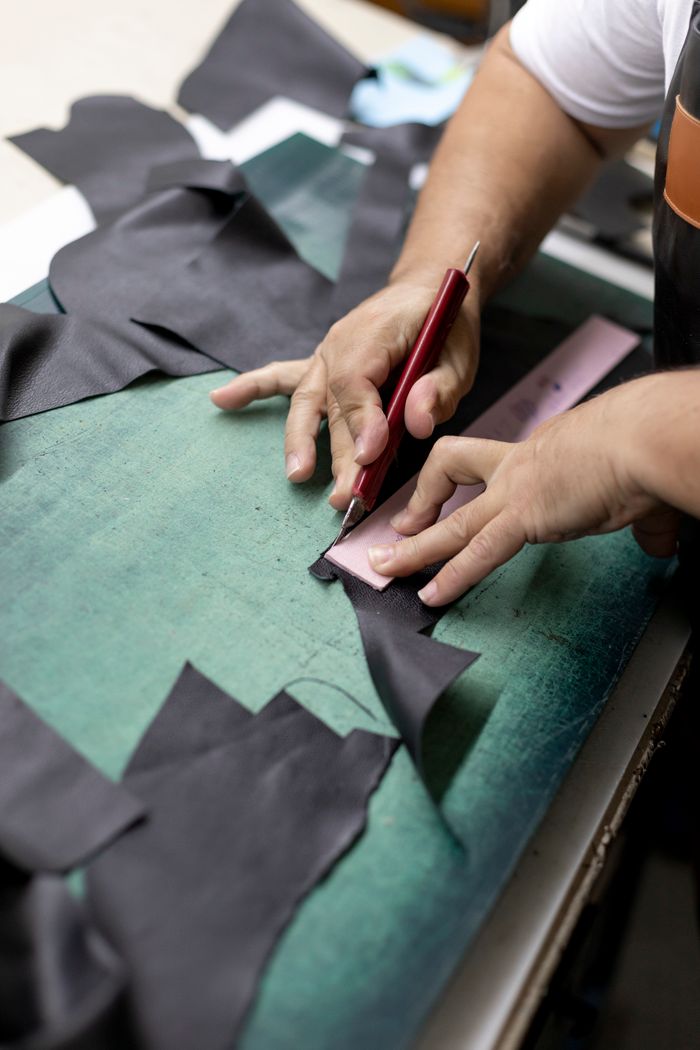
leather Patchwork and inlay design Construction
Block Patchwork
Large geometric panels in two, three or four tones. The signature of western wear, varsity outerwear and heritage biker jackets. Fewest pieces, lowest cost, fastest lead time — and the technique we recommend for a brand's first patchwork run.
Mosaic & Micro-Patchwork
Dozens or hundreds of small pieces building a gradient, image or texture field. Visually spectacular and expensive: piece count drives both cost and failure risk. We cap mosaic runs at what our QC can genuinely inspect, and we will tell you when a design has too many pieces to hold its shape over time.
Contrast Panel Patchwork
Sleeves, yokes, side panels and collars in a contrasting hide or colour. The commercial workhorse — high visual impact, minimal added cost, and it does not compromise the garment's structure.
Texture Patchwork
Mixing smooth cowhide, pebbled goatskin, suede and embossed exotic-print leathers in a single panel. Texture contrast reads as luxury even in a single colourway, which makes it a strong option for monochrome collections.
Repair-Style & Distressed Patchwork
Deliberately irregular, visible-stitch patchwork evoking repaired vintage leather. Heavily requested by streetwear and Americana labels. Every piece is genuinely irregular — we do not run a template and call it distressed.
Leather patchwork and Inlay design Techniques
Flush Inlay
The standard. A cavity is cut into the base hide, a contrasting piece is cut to match within ±0.2 mm, and it is set flush and secured from the reverse. Correctly executed, you cannot feel the transition with a fingertip.
Logo & Monogram Inlay
Brand marks built into the leather rather than stamped onto it. This is the highest-value inlay application for B2B clients: permanent, unfakeable and impossible to peel. Requires clean vector artwork with closed paths.
Layered Relief Inlay
The inlay sits marginally proud of the base surface, catching light at its edge. Useful when you want the motif to be tactile as well as visual — common on bags and journal covers.
Reverse Inlay
The motif is cut from the contrasting hide, and the base leather shows through the negative space. Structurally the same operation, visually the opposite result — and it costs the same, which surprises most buyers.
The Engineering Constraints You Should Design Around
These are not preferences. They are the physical limits of the technique, and designing past them is the single most common reason a first sample fails.
- Minimum inlay feature width: 3 mm. Anything thinner cannot be cut cleanly, seated reliably, or held in place under flex.
- Thickness matching: ±0.2 mm. Base and inlay hides must be split to matching thickness or the inlay will sit proud or sunken. This is why inlay demands in-house tanning control.
- Internal corners: sharp internal angles under 45° will not cut cleanly. Radius them to 1 mm minimum.
- Flex zones: avoid patchwork seams and inlay edges at elbows, underarms, shoulder breaks and bag base corners. Every seam is a stress concentration.
- Grain direction: leather stretches differently along and across the hide. Adjacent patchwork pieces must be cut in matching grain direction or the panel will distort within months. We map this at pattern stage.
- Colour batch: contrasting hides must come from a single dye lot. Two "black" hides from different lots will read as two different blacks under daylight, and the customer will see it even if the buyer does not.
- Piece count vs durability: every additional seam is a potential failure point. Below roughly 40 pieces per panel, durability is unaffected. Above that, we specify reinforcement backing.
Frequently Asked Questions
Patchwork joins separate leather pieces edge-to-edge to build a panel, leaving visible seams and slight relief at each joint. Inlay cuts a shape out of the base leather and sets a contrasting piece into the resulting cavity, sitting flush with the surrounding hide. Patchwork adds material; inlay replaces it. Patchwork suits bold geometric blocks, while inlay suits logos, monograms and precision motifs where you want the design to read as part of the hide rather than applied to it.
Yes, when engineered correctly. Every seam is a stress point, so durability depends on grain-direction matching, correct skiving, reinforcement backing on high-piece-count panels, and keeping seams out of high-flex zones such as elbows and bag base corners. Properly built patchwork outlasts every surface decoration method, because there is no applied layer that can crack or peel the design is the material.
Below that, the cut path cannot be executed cleanly, the piece cannot be seated reliably, and it will not stay flush under flex. Internal corners should be radiused to at least 1 mm. If your artwork contains detail below these thresholds, we will redraw it to a workable specification and send it for your approval before cutting.
Low, and we sample genuinely. Patchwork and inlay carry a pattern engineering cost rather than a tooling cost, so unlike die-based methods there is no large minimum run required to amortise setup. Ask us for a specific figure with your design piece count matters more than order quantity.
Yes smooth cowhide, pebbled goatskin, suede and embossed leathers can be combined, and texture contrast is one of the strongest design tools available in a single colourway. The constraint is thickness: mixed materials must be split to compatible thickness or seams will ridge. We handle this at hide-selection stage.
Yes smooth cowhide, pebbled goatskin, suede and embossed leathers can be combined, and texture contrast is one of the strongest design tools available in a single colourway. The constraint is thickness: mixed materials must be split to compatible thickness or seams will ridge. We handle this at hide-selection stage.
Pattern engineering and sampling: 10 to 14 working days. Production: 15 to 30 working days depending on piece count, order size and whether the design requires reinforcement backing. Mosaic and micro-patchwork sit at the long end of that range.
They will if the hides came from matching dye lots, which is why we reserve lots for the full production run. Leather from different lots ages at different rates and will visibly diverge over time, even when the initial colour match looks perfect. This is the most common defect we see in patchwork sourced from suppliers who buy hides on the open market.